

Deep Voices 127 on Spotify
Deep Voices 127 on Apple Music
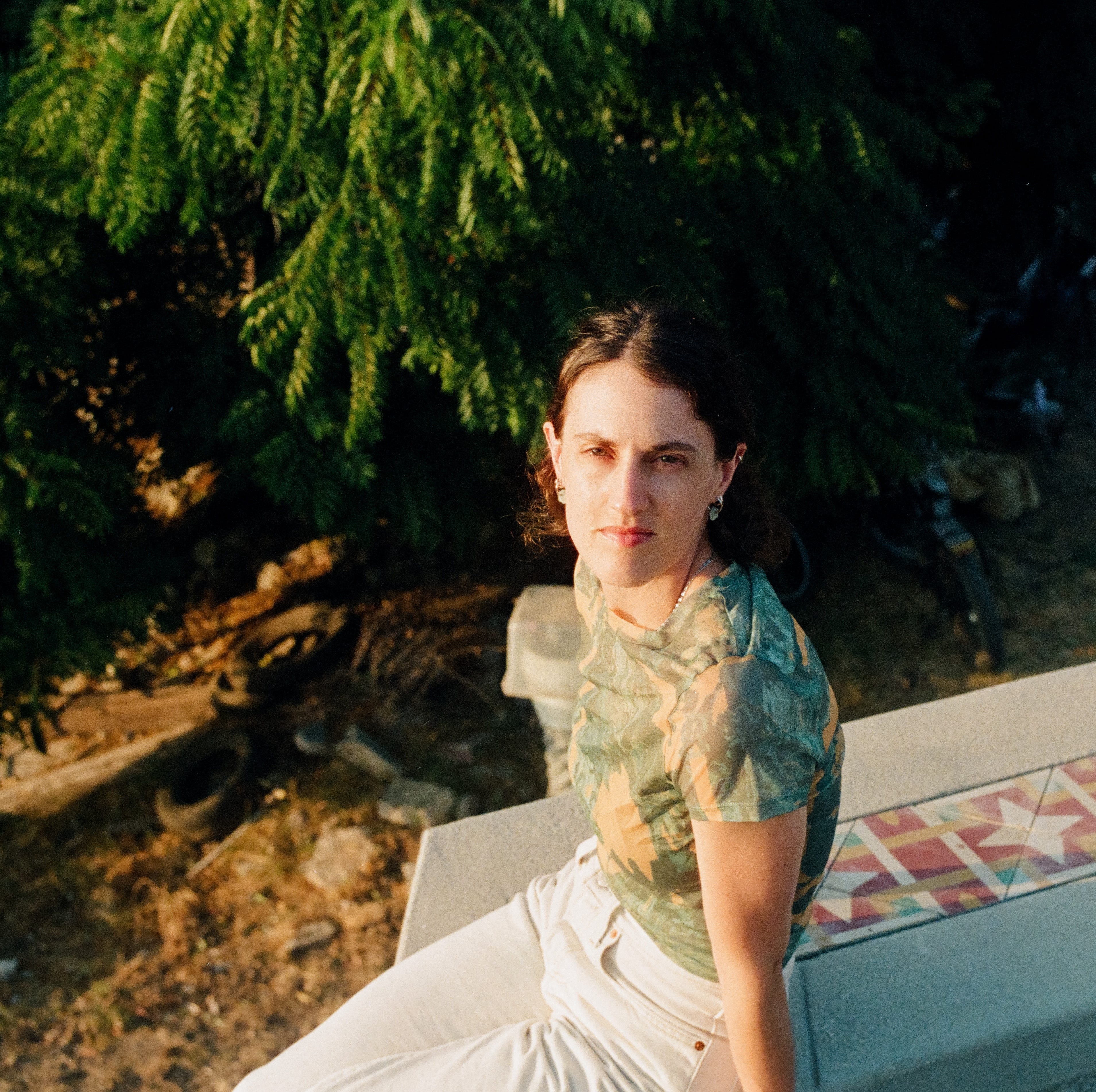
Photo: Sam Lee
This edition of Deep Voices is an interview with the composer and producer Celia Hollander, whose work I’ve long admired. Her most recent album, Perfect Conditions, is self-released. The above playlist, “Just Clear Water,” is compiled by Hollander. If you enjoy this interview, please consider a paid subscription to Deep Voices to keep this project going. Thank you!
Nine years ago I went to see a performance by the artist Madeline Hollander, “Drill.” It took place in a warehouse gallery in Brooklyn, with several dancers snaking around the room in choreography adapted from airplane emergency evacuation plans. I loved the piece, but I was curious about the music, a pulsing, ecstatic composition that straddled techno and modern classical music with equal fervor. It was made specifically for “Drill,” it turned out, a three hour score by the artist $3.33 aka Celia Hollander, Madeline’s sister.
As I explored Celia’s catalog, first as $3.33 and later under her own name, I found her music to be uniformly excellent, sometimes loopy and frenzied, other times bold and expansive. Her work on the piano, in particular, fast and fierce, felt special. I was really astonished by her album Second Draft, comprised of manipulated solo piano recordings she made mostly on her phone. It sounded connected to California artists like Harold Budd and Lou Harrison, dreamy but deep.
Celia released a number of albums on California’s Leaving Records, and late last year, she self-released Perfect Conditions, an album of 16 tracks that imagine the sound of combinations of the four elements: earth, air, water, and fire. “Air / Earth” has a subtle hiss and the playful pitter-patter of wind chimes. “Earth / Earth” feels like funky ’80s jazz party music.
“Water / Earth,” however, is much more wild, with the feeling of a rainstorm in the distance closing in on you.
Not long after the album’s release came the L.A. wildfires. Hollander, an L.A. native who had been living in Altadena, lost her house. When we talked a few weeks ago, she was temporarily living in Joshua Tree, where she said she was enjoying the silence. She spoke about her experience with the fires and about her freeform approach to composition. Celia also made a playlist she titled “Just Clear Water.” It’s really beautiful, very serene. It’s also about two hours long, twice as long as the normal Deep Voices playlist. She asked me if she should cut it down, but I figured it was nice to give her some space.
I had this thought, thinking about the playlist you made and your music, that your music is distinctly California. I wanted to run that theory by you.
I think my fear with having the title Perfect Conditions was that people would interpret it in the New Age California sense, which is that everything is just perfect, like perfect conditions to fly a kite like blue sky day. I was thinking less about the elements themselves and more about combinations of forces and how it takes all of these variables working together in just the right ways to create different phenomena, and using that as a metaphor. That’s tangibly what music is, all of these different sources of audio and random choices in production coming together to make this product that might not be able to be repeated.
Perfect Conditions is made up of combinations of elements of water, air, earth, and fire. How did it come together?
The first tracks were all the earthy ones. A lot of them use these same rock or gravel samples. I had this digital world palette in Ableton, and I kept on duplicating it and making little changes in instrumentation. And then I felt like I had this body of work that felt very earthy.
What do you mean by a rock sample?
It was a combination of recordings that I had taken of just like rubbing a rock on gravel as well as samples from a very old sample library I had on an old CD from CalArts.
How'd you pick the rocks?
Um, not with much thought or care. I made a choice at one point to not sample other people's music, but using audio of anything textural has played a big role for me. I'm not very precious about what it actually is, it comes down to what happens when it's dropped into the digital waters of Ableton. Second Draft, my previous album, that was recorded terribly. It was recorded on my iPhone and a zoom mic. And that comes through somewhat; it's not a wonderfully recorded album by professional engineers’ standards. But it's more about how it gets treated. And sometimes it's really surprising, a really bad sample that isn't clear might become the most pivotal part of a song just because of how it reacts when it gets processed.
What are the other ways that you created the different elements for your sound bank?
I think the rocks are the only direct sample of an element that it's being referred to. Everything else is abstracted interpretations of forces colliding.
When you walk around, what kind of listener are you?
A sensitive one.
What does that mean?
Like, I can't live in New York. It's so crazy. I love being in New York City, but I can't not hear everything in a very sensitive way.
What sounds sound good to you?
I like airy, chordal sounds. So fog horns, doves, pipe organs. Clusters of air sound really warm and soothing to me. Textural sounds, brown noise, crinkling paper. ASMR, basically.
And what sounds bad?
I used to live in Highland Park in L.A., and I lived there through the pandemic, and the fireworks were just out of control all of the time. I would really describe them to be as loud as bombs, extremely loud any time of day, any time of night. [I don’t like] constantly being interrupted by loud noises. I feel like phone notifications can fall into that category. I think probably most people would agree with that.
Are you aware of misophonia, the condition where hearing certain sounds can drive a person up a wall?
I definitely have that. I have that with, like, people chewing gum.
Is it strange to make your life based around sound when sound seems like it might also have the power to drive you nuts?
I think part of making music is crafting what you want to listen to and what kind of soundscape you want to be in. If you're really sensitive to sound, you'll have a special attunement to where you want to be, sonically, right?
Where is it you want to be?
That feels like an especially poignant question, because I'm trying to figure out housing for longer than two months into the future. That question is the big question. I'm really happy right now in the desert. It's extremely serene and quiet.
You have made a lot of serene and quiet music. I’m really fond of Second Draft, which is a solo piano album.
I consider Second Draft an electronic music album. It's not composed piano. It was hours and hours of me improvising on the piano, recorded pretty terribly, and then really processed in Ableton. So sped up, slowed down, layering, and delay, just ways that it isn't just microphone to piano. To me, that quality is what makes it special. I mean, improvising is the only way I can play piano.
Do you know how to read music?
I can barely read music. I also have no interest in playing other people's music on the piano. That's not what it's there for. It's kind of like drawing; I wouldn't want to draw other people's pictures or paintings. I don't know why that same standard is held for music.
How did you learn to play music?
I’m very grateful to have had classical piano lessons as a kid, and then I joined a jazz band in middle school, so I stopped playing classical piano and was learning to read jazz chord charts, and then improvising came into the picture. That's when I started to really love music. Before that it didn't feel creative at all. Then I started recording with a digital four track in high school.
What kind of music were you making?
Kind of like what I make now, playing music with keyboards and random sounds and some singing.
I first got introduced to your music when you were using the name $3.33. I heard a score you’d made for a performance of your sister’s and I thought it sounded crazy, like Philip Glass making techno. Where did that sound come from?
I'm not entirely sure, but I do know that I felt no consequences making music under $3.33. I never really thought about people listening to it. The benefit of using the moniker $3.33 is that it's outside yourself, and whatever you put out doesn't really matter. I would put that name on a flyer for a performance and people still wouldn't know that anyone with that name was performing. They thought the show was that amount of money. It was like wearing a mask.
Did it feel good to be able to disappear? Could you experiment more?
Yeah. I think I was trying to not take it seriously and not be looked at. It also wasn't my job in any way. I always worked as a studio assistant for visual artists and I had a big separation between how I made money and music. Music was this feral thing that I did at night on a computer. Through working with Madeline, though, I was getting more opportunities for other scoring projects, which ignited this idea that music could be what I do all day and I decided to go back to school, to CalArts for music. During that time, I also chose to release music under my name. With $3.33, any internet attention I was getting tended to assume that I was a guy, because I had no photos of me online. I just felt like if I don't put stuff under my name or represent myself, people will make assumptions. If I don't represent myself, no one else will.
Why do you think people thought you were a guy?
Because most crazy electronic music is made by that demographic.
How did that make you feel?
A part of me enjoyed it, as well as felt misunderstood. I think the enjoyment is feeling like being a trickster, or ultimately wanting some music to be separate for me. I'm not making music that is supposed to be about my identity. My ideal is that it has a life beyond whoever I am. I have nostalgia for a time, like with an artist like Aphex Twin, where you could cloak your identity and try to keep some quote, unquote purity about what the music is. We're in a really different time now for so many reasons. I think things are a little bit different if you're not the usual demographic, which is what I experienced. If you don't want to be misunderstood, that's no one's responsibility, but your own.
What happened to you during the fires?
I've lived in L.A. most of my life. I've seen a lot of wildfires. January 7th, 2025, was truly the perfect conditions for a huge brush fire. There were hurricane-level winds, 80 to 100 miles per hour. I lived in Altadena and the Eaton fire started around 6PM on the 7th. I had no reason to believe that our neighborhood would be impacted so seriously. I left the house because it was really smoky and I'm very sensitive to smoke. Where I lived was not close to the mountain. My house had a fire insurance rating of two out of 30. That's how low the risk felt in my flat suburban area. But I took it seriously as a fire drill, taking essentials. Within hours, our entire neighborhood was leveled.
I'm really sorry.
Thank you. It's very strange because it's like multiple levels of loss, and at the same time, it has nothing on many other types of loss. One thing that has been really helpful as a process is that it's such a collective trauma. It really is something that I'm going through with everybody in the neighborhood and the city. Everyone's impacted in some way and I've gotten a lot of support. In a way that a lot of other types of grief, you feel really isolated. I feel really connected and supported, so I'm thankful for that.
You performed this past weekend, your first time since the fire. How did it feel?
I think it felt good, actually. It made me feel connected to who I am and what I actually care about.
What is it you care about?
What do I care about? I care about music and community and sharing time and space with people. Those are some of the things. There are probably other things. But I care about those things more than being on the phone with different insurance companies. You start to forget who you are after neglecting what you really care about for too long.
Tell me about how you pulled together this playlist.
My whole reality has just gone through a Boggle shake up in the past months. I still love music, it's still there, but it's just of a different dimension. I haven't been listening to that much music this month, to be honest, because I don't really have speakers or a car or the usual places that I would listen to music, but when I have, I've basically needed to listen to what I would call, “big picture” music. A lot of other music has felt either too over stimulating or too hammy or just not what I need right now. Being in a desert has felt like a blessing. It's been a lot of big decisions really quickly, lots of calls with insurance, lots of calls with medical insurance, car insurance, renter’s insurance. So I've gravitated to this type of music, which has a clarity to it.
What does “big picture” music mean to you?
A lot of this music is in no rush. It’s not trying to compete with anything else, and it's not trying to get its message out in a quick way to be entertaining, necessarily. A lot of this music definitely isn't trying to be anything.